
What can be obtained, and on what basis
Polish records for citizenship-by-descent matters sit in three custodial systems — civil registry offices, the State Archives, and church archives — plus a separate collection for the territories Poland lost in 1945. We establish which one holds your client’s document, obtain it as your appointed representative in Poland, and deliver it with the issuing institution and its reference cited.
Where the records sit
Civil registry offices (USC). Hold civil-status books still within the statutory custody periods — 100 years for births, 80 years for marriages and deaths, counted from the end of the year the record was drawn up (art. 28 of the Civil Status Records Act of 28 November 2014). A request can be filed by post to any registry office in Poland, or through a representative. Produces an abridged or full certified copy (odpis skrócony, odpis zupełny).
The State Archives. Hold the books once those periods expire, together with duplicate church registers. Where holdings are not indexed, the archive can be commissioned to search them for a fee and handles it remotely; where they are indexed or scanned, some branches will decline a search and expect the record to be identified first. Produces a certified copy issued by the archive — a different instrument from a registry-office copy, and we tell you which one a given matter will yield.
Diocesan and parish archives. Written correspondence, and the institution is under no obligation to answer — some do not, and we say so before a matter comes to depend on it. Where the same register survives as a duplicate in the State Archives, and for much of central Poland it does, we take the state route first: it produces a document with a citable institutional reference.
The eastern territories. Civil-registry books drawn up before 1945 east of the Bug and later evacuated to Poland are held by the civil registry office in Warsaw — the “Bug River” collection (księgi zabużańskie) — not by an archive, so for those matters the request goes there. Church and pre-1918 records from the same territories sit partly with AGAD in Warsaw and partly with archives in today’s Ukraine, Belarus and Lithuania: expect a longer timeline and a materially higher risk of a negative result.
What releases the record
Access to a certified copy is closed by statute — art. 45 of the same Act — to the person the record concerns, their spouse, ascendants, descendants, siblings, legal representative or guardian, and anyone showing a legal interest. Your client, as a descendant, is within that circle. What blocks them is execution: the electronic route runs through a Polish trusted profile (profil zaufany) or e-ID, which presupposes a PESEL number your client will not normally hold, and the postal route requires correspondence in Polish and documented proof of the chain of kinship. An appointed representative in Poland resolves exactly that.
An ancestor who held Polish citizenship under the 1920 Act was typically born between 1900 and 1935, so a birth record drawn up in 1930 stays with the registry office until the end of 2030. An indexed entry in a genealogical database, or a scan published online, is useful working material and nothing more — the filing needs the instrument.
Coverage, and its limits
Territory: the area of the interwar Polish state.
Languages we work in: Polish; Russian in Cyrillic script (Russian partition, from 1868); German, much of it in Kurrent handwriting (Prussian partition, and the territories annexed by Germany between 1939 and 1945); Latin (Catholic parish registers and Austrian registry forms); Ukrainian in Cyrillic in Greek Catholic parishes. Where a record falls outside that range, we say so before the matter comes to depend on it and price the specialist work separately.
What we do not claim: that a record survived — wartime losses and gaps in holdings are real; that an institution will reply — some do not; that a result will be positive. Where a search closes negative, you receive a documented negative result. The full list of exclusions is on For law firms.
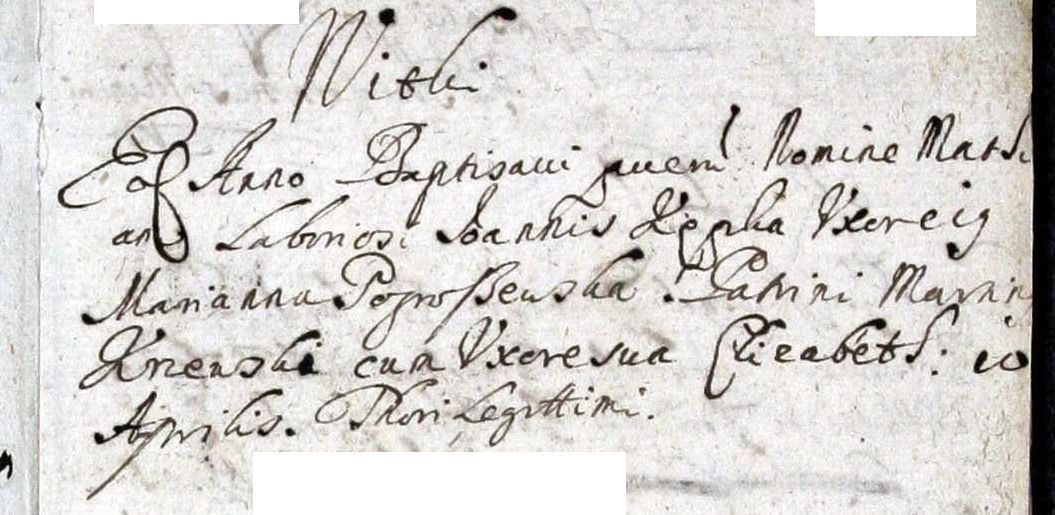
Baptism of Maciej Kępka — Witki, 1669. Roman Catholic parish of Rokitno, Warsaw West County, register of baptisms and marriages 1664–1710, Skanoteka 7145d, vol. 100. Latin. Son of Jan Kępka and Marianna Pogroszewska, both entered as laboriosi — peasants.
Scan: Polskie Towarzystwo Genealogiczne, metryki.genealodzy.plOriginal: Archiwum Archidiecezjalne Warszawskie, Skanoteka 7145d, vol. 100
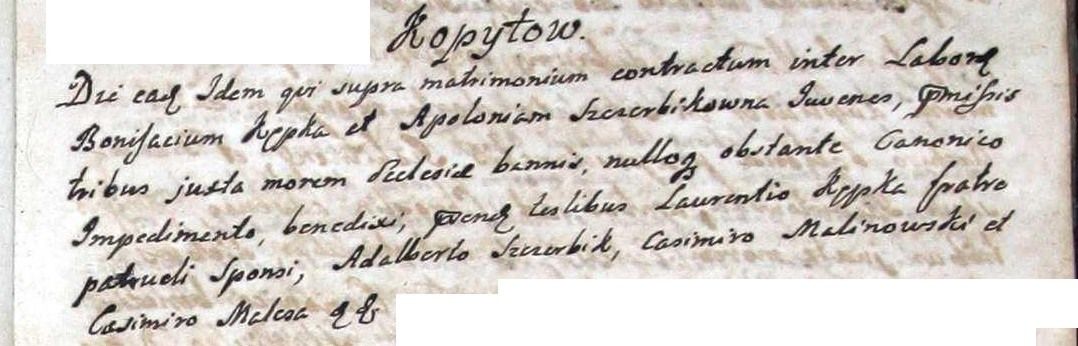
Marriage of Bonifacy Kępka and Apolonia Szczerbik — Kopytów, 1766. Rokitno, register of marriages 1750–1802, Skanoteka 7145d, vol. 108. Latin. Both entered as unmarried. Among the witnesses, Wawrzyniec Kępka, described as frater patruelis sponsi — the son of the groom’s father’s brother. Kinship stated to that precision is how a line is rebuilt where no index reaches.
Scan: Polskie Towarzystwo Genealogiczne, metryki.genealodzy.plOriginal: Archiwum Archidiecezjalne Warszawskie, Skanoteka 7145d, vol. 108

Birth record no. 55 — Kraszewo, 1 October 1905. The birth of Bronisław Kempczyński at Osiek, reported by his father Józef. Civil register kept in Russian by the parish priest, under the law of the Russian partition.
Scan: Polskie Towarzystwo Genealogiczne, metryki.genealodzy.plOriginal: Archiwum Państwowe w Warszawie Oddział w Mławie, fonds 76/144/0, act 55/1905
Between the 1801 entry and the 1905 entry the family name changes. Walenty, born Kępka in 1770, is recorded as Kempczyński from 1817, when his son Maciej is baptised; his children appear under both names for another generation. Adding -ski was a common way for a peasant family to raise its standing on paper. A search for Kempczyński stops in 1817. The earlier records exist. They are under a different name.
Send us one test case.
One ancestor, one record. You get a written feasibility note before any work starts, so you can judge the fit at no risk to your matter.