
Worked example: one line, 1669 to 1905
This is a deliverable in the form your firm would receive one, on a line we researched ourselves. Five records, each with the institution that holds it and the reference we can quote for it, a level of confidence on every finding, and the source log in full. Every supplier publishes a redacted sample because a client has to be protected. Here there is no client, so nothing is withheld.
The line
Eight generations in the male line, from a peasant baptised in a Mazovian parish in 1669 to a birth registered in Russian in 1905. All persons named are long dead; the line as reproduced here stops at Bronisław, who died in 1967.
Maciej Kępka 1669–1737 → Paweł Kępka b. 1698 → Bonifacy Kępka d. 1801 → Walenty Kępka → Kempczyński 1770–1828 → Maciej Kempczyński 1817–1855 → Piotr Kempczyński 1840–1920 → Józef Kempczyński b. 1871 → Bronisław Kempczyński 1905–1967
The finding that decides a case like this
Between the 1801 entry and the 1905 entry the family name changes. Walenty, born Kępka in 1770, is recorded as Kempczyński from 1817, when his son Maciej is baptised; his children appear under both names for another generation. Adding -ski was a common way for a peasant family to raise its standing on paper. A search for Kempczyński stops in 1817. The earlier records exist. They are under a different name.
This is the failure mode that kills descent matters on “no documents survive”. No amount of better index searching reaches it, because the index is not wrong — the name is.
The records
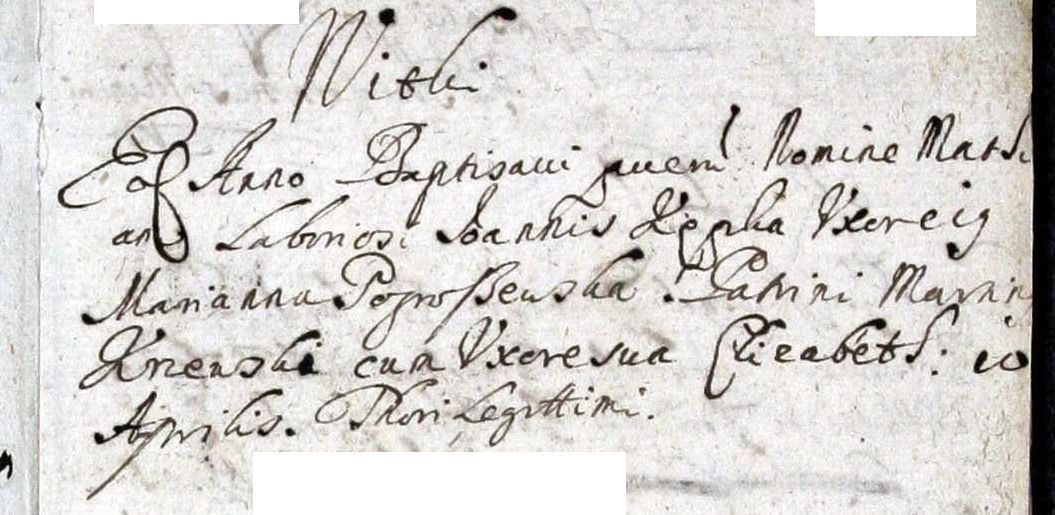
Baptism of Maciej Kępka — Witki, 1669. Roman Catholic parish of Rokitno, Warsaw West County, register of baptisms and marriages 1664–1710, Skanoteka 7145d, vol. 100. Latin. Son of Jan Kępka and Marianna Pogroszewska, both entered as laboriosi — peasants.
Scan: Polskie Towarzystwo Genealogiczne, metryki.genealodzy.plOriginal: Archiwum Archidiecezjalne Warszawskie, Skanoteka 7145d, vol. 100
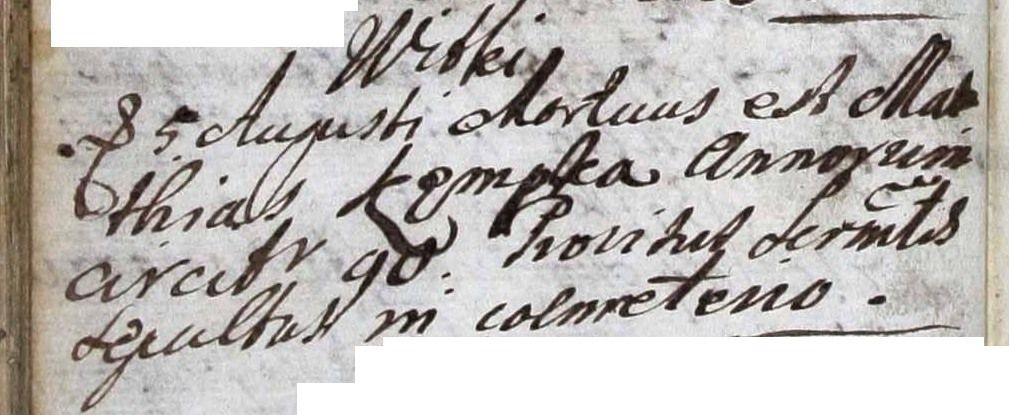
Death of Maciej Kępka — Witki, 1737. Rokitno, register of deaths 1703–1802, Skanoteka 7145d, vol. 110. Latin. Age given as circiter 90; his baptism of 1669 puts him at 68. Before the nineteenth century, age at death was estimated from appearance, not read from a document. Seven weeks earlier the same hand entered, on the same page and from the same village, the death of Krzysztof Kępka at circiter 30 — a man who had a child baptised in 1721 and so was forty at the very least. One age wrong by twenty-two years, another by at least ten, in opposite directions, on one page. We report the entry and the arithmetic, never one in place of the other — which is why the identification above is carried as probable, not confirmed.
Scan: Polskie Towarzystwo Genealogiczne, metryki.genealodzy.plOriginal: Archiwum Archidiecezjalne Warszawskie, Skanoteka 7145d, vol. 110
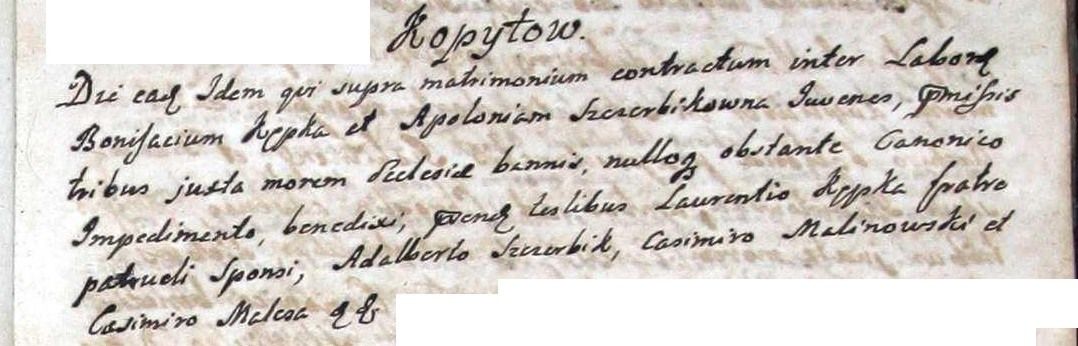
Marriage of Bonifacy Kępka and Apolonia Szczerbik — Kopytów, 1766. Rokitno, register of marriages 1750–1802, Skanoteka 7145d, vol. 108. Latin. Both entered as unmarried. Among the witnesses, Wawrzyniec Kępka, described as frater patruelis sponsi — the son of the groom’s father’s brother. Kinship stated to that precision is how a line is rebuilt where no index reaches: it is the only reason Bonifacy can be placed in this family at all, since no entry names his father.
Scan: Polskie Towarzystwo Genealogiczne, metryki.genealodzy.plOriginal: Archiwum Archidiecezjalne Warszawskie, Skanoteka 7145d, vol. 108
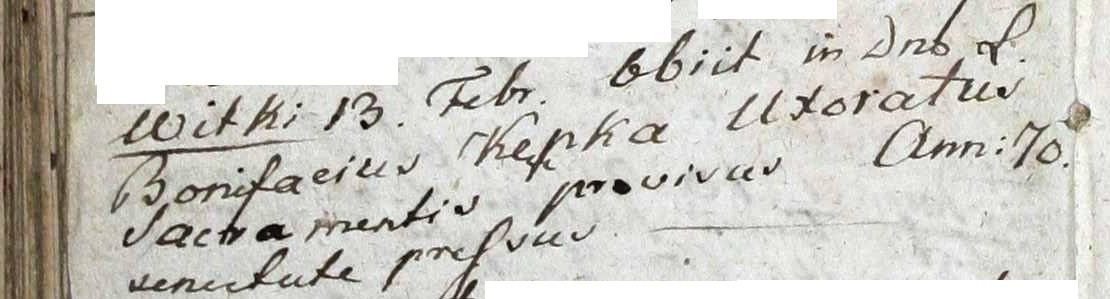
Death of Bonifacy Kępka — Witki, 13 February 1800 or 1801. Rokitno, register of deaths 1703–1802, Skanoteka 7145d, vol. 110. Latin. Age 70, again by estimate. Sacramentis provisus, senectute pressus — attended with the sacraments, weighed down by old age. The entry itself carries no year: it runs under a heading that reads Annus Dni 1800, while the parish index dates it to 1801. We have not resolved which is right, so both are carried. An entry is only ever as precise as what is written on the page.
Scan: Polskie Towarzystwo Genealogiczne, metryki.genealodzy.plOriginal: Archiwum Archidiecezjalne Warszawskie, Skanoteka 7145d, vol. 110

Birth record no. 55 — Kraszewo, 1 October 1905. The birth of Bronisław Kempczyński at Osiek, reported by his father Józef. Civil register kept in Russian by the parish priest, under the law of the Russian partition. Two things are legible at a glance. The margin names the village — Осекъ, Osiek — where the parish index records only the commune, Ojrzeń; a filing that carries the index value carries the wrong place of birth. And the family name is written twice in one line: Кемпчинскій, and in brackets Kempczyński.
Scan: Polskie Towarzystwo Genealogiczne, metryki.genealodzy.plOriginal: Archiwum Państwowe w Warszawie Oddział w Mławie, fonds 76/144/0, act 55/1905
Transcription and translation — opening of act no. 55
Осекъ. № 55. Состоялось въ деревнѣ Крашевѣ Сентября восемнадцатаго / Октября перваго / дня тысяча девятьсотъ пятаго года, въ часъ пополудни. Явился лично: Іосифъ Кемпчинскій (Józef Kempczyński) работникъ тридцат[…]
“Osiek. No. 55. Done in the village of Kraszewo on the eighteenth day of September / the first of October / one thousand nine hundred and five, at one in the afternoon. There appeared in person: Józef Kempczyński (Józef Kempczyński), labourer, aged thirty[…]”
Three things a filing turns on are visible in those few lines. The double date — 18 September by the Julian calendar then in official use, 1 October by the Gregorian — which is why one event can appear under two dates and be read as two. The double spelling of the surname, Cyrillic and Latin in the same breath, which is the bridge between an index in one alphabet and a case file in another. And the gap between birth and registration: the child was born on 9 / 22 September, the act was drawn up on 18 September / 1 October. Both dates are doubled, and only the second pair stands in these opening lines — which is how a birth on 22 September comes to be filed as 1 October.
Levels of confidence
Each finding carries one of three levels, applied as set out under Methodology. Three of the seven below are not confirmed, and they are printed here for the same reason they would be printed in your matter.
| Finding | Level | Basis |
|---|---|---|
| Maciej Kępka, son of Jan Kępka and Marianna Pogroszewska, baptised at Witki in 1669 | Confirmed | Baptism entry reproduced below; parents named in the entry. |
| The same Maciej Kępka died at Witki in 1737 | Probable | Death entry names him and the place, but gives his age as “about 90”, against 68 by the 1669 baptism. No second adult Maciej Kępka is recorded in the parish at that date — but this register demonstrably drops entries, so absence from it carries little weight. The identification rests on name and place. |
| Bonifacy Kępka married Apolonia Szczerbik at Kopytów in 1766 | Confirmed | Marriage entry reproduced below, with a witness described as the groom’s first cousin. |
| Bonifacy Kępka was the son of Paweł Kępka | Probable | No record names Bonifacy’s father. The 1766 entry below calls a witness the groom’s first cousin on the father’s side; that witness, Wawrzyniec Kępka, was baptised in 1722 as a son of Krzysztof — which places Bonifacy’s father as a brother of Krzysztof. Paweł fits: he married at Kopytów in 1729 and died there in 1735, and Bonifacy lived at Witki and Kopytów. The baptism that would close it is not in the register. |
| Bronisław Kempczyński was born at Osiek on 22 September 1905 | Confirmed | Birth act no. 55/1905, reproduced below. The act names the village, Osiek; the parish index gives only the commune, Ojrzeń. |
| The family name changed from Kępka to Kempczyński with Walenty, from 1817 | Probable | Established in the underlying research. The entry that carries it is not among the five records reproduced here, so this example does not evidence it. |
| The Rokitno family of the eighteenth century and the family at Osiek in 1905 are one line | Unverified | Roughly 80 km and five generations separate them. No record reproduced here joins the two parishes. Stated as open, because that is what it is. |
Source log
| Item | Holding institution | Reference | Status |
|---|---|---|---|
| Baptism, Maciej Kępka, 1669 | Archiwum Archidiecezjalne Warszawskie | Skanoteka 7145d, vol. 100 | Scan — working material |
| Death, Maciej Kępka, 1737 | Archiwum Archidiecezjalne Warszawskie | Skanoteka 7145d, vol. 110 | Scan — working material |
| Marriage, Bonifacy Kępka, 1766 | Archiwum Archidiecezjalne Warszawskie | Skanoteka 7145d, vol. 108 | Scan — working material |
| Death, Bonifacy Kępka, 1800 or 1801 | Archiwum Archidiecezjalne Warszawskie | Skanoteka 7145d, vol. 110 | Scan — working material; year of the entry unresolved |
| Birth, Bronisław Kempczyński, act 55/1905 | Archiwum Państwowe w Warszawie, Oddział w Mławie | fonds 76/144/0, act 55/1905, sheet 28 | Scan — working material; certified copy obtainable against this reference |
Scans of the four Rokitno entries are reproduced by courtesy of the Polish Genealogical Society, which digitised them; the originals are held by the archives named above. Attribution is part of the deliverable, not a footnote to it.
One caveat on the references, because the two kinds in that column are not equivalent. For the 1905 act, 76/144/0, act 55/1905, sheet 28 is the state archive’s own signature and can be quoted to it directly. The four Rokitno references are not signatures at all: 7145d and the volume numbers identify the material inside Skanoteka, the digitisation repository, and Archiwum Archidiecezjalne Warszawskie does not hold its collection under them. Ordering from that archive needs its own reference, which we have not yet obtained. A repository identifier dressed as an archival one would read better in this table and send your clerk to the wrong counter.
What this example does not show
The scans reproduced here are working material. A scan is not an instrument: a filing needs a certified copy issued by the archive, and the reference in the source log is what it is ordered against. The five generations between the last Rokitno entry and 1905 are documented in the underlying research but not reproduced here, which is why the line itself is carried as unverified above. Two joints inside the Rokitno stretch are open on the record and carried as such: whose son Bonifacy was, and the year in which he died.
Send us one test case.
One ancestor, one record. You get a written feasibility note before any work starts, so you can judge the fit at no risk to your matter.