
How we establish and report a finding
Every fact we report is recorded with the source it came from, conclusions are kept separate from what the record actually says, and each finding carries a stated level of confidence. You can check any line of a deliverable against the institution that issued it, without taking our word for it.
Every fact carries its source
A finding is entered with the institution holding the record, its reference, the type of entry and its date. Where there is no source, there is no fact — what we infer is marked as an inference, not reported as established. The effect for your firm is that provenance is auditable: when the deciding authority questions a name, a date or a place, you trace it back to the entry it came from and produce the copy, rather than reopening the search.
Levels of confidence
Each finding is assigned one of three levels. Confirmed rests on a record we obtained and read. Probable means the record supports it but the identification is not closed — a name matching with a spelling variant, a date falling within a range. Unverified comes from an index, a database entry or a family account and has not been checked against the original. Levels are stated per finding, not per document, so one copy can carry a confirmed date of birth and a probable parish of origin. That tells you which parts of a matter will hold up in a filing.
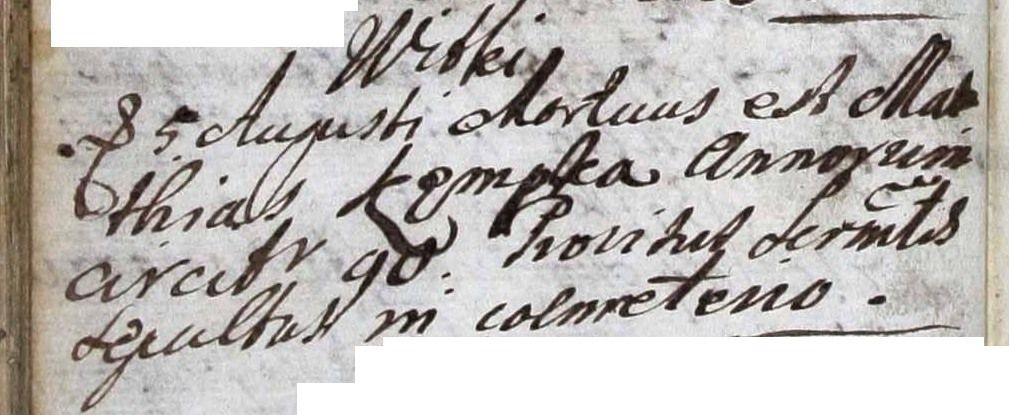
Death of Maciej Kępka — Witki, 1737. Rokitno, register of deaths 1703–1802, Skanoteka 7145d, vol. 110. Latin. Age given as circiter 90; his baptism of 1669 puts him at 68. Before the nineteenth century, age at death was estimated from appearance, not read from a document — a field labourer of 68, worked in sun and wind, could pass for ninety. We report the entry and the arithmetic, never one in place of the other.
Scan: Polskie Towarzystwo Genealogiczne, metryki.genealodzy.plOriginal: Archiwum Archidiecezjalne Warszawskie, Skanoteka 7145d, vol. 110
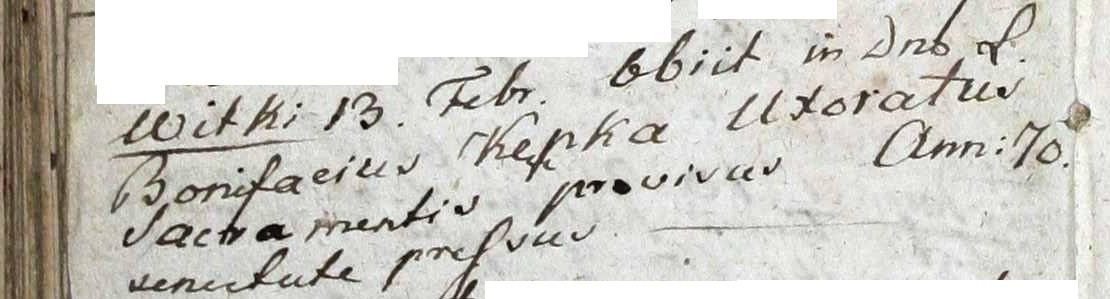
Death of Bonifacy Kępka — Witki, 13 February 1800 or 1801. Rokitno, register of deaths 1703–1802, Skanoteka 7145d, vol. 110. Latin. Age 70, again by estimate. Sacramentis provisus, senectute pressus — attended with the sacraments, weighed down by old age. The entry carries no year of its own: it runs under a heading reading Annus Dni 1800, while the parish index dates it to 1801. Unresolved, so both are carried.
Scan: Polskie Towarzystwo Genealogiczne, metryki.genealodzy.plOriginal: Archiwum Archidiecezjalne Warszawskie, Skanoteka 7145d, vol. 110
How a negative result is reported
A negative result is reported with the same detail as a positive one: what was asked, which institution was queried, under what reference, what it answered, and what that rules out. If the register for the relevant years did not survive, or the archive holds the fonds but not the entry, you receive that in writing with the correspondence behind it. It is a deliverable, not a failed job — it lets you close a matter that cannot be proved, or redirect it to a surviving route, instead of paying for the same search twice.
Send us one test case.
One ancestor, one record. You get a written feasibility note before any work starts, so you can judge the fit at no risk to your matter.